Claryoo
Customer service training PPT with real phrases and role-play
A free customer service training PowerPoint template: 14 slides with speaker notes, a poll, a quiz and a volunteer pick. Edit it in PowerPoint or Google Slides, or run it live on Zoom, Meet, Teams or in the room.
Free, no sign-up. 14 slides, about 73 minutes, speaker notes on every slide. Opens in PowerPoint, Google Slides and Keynote.
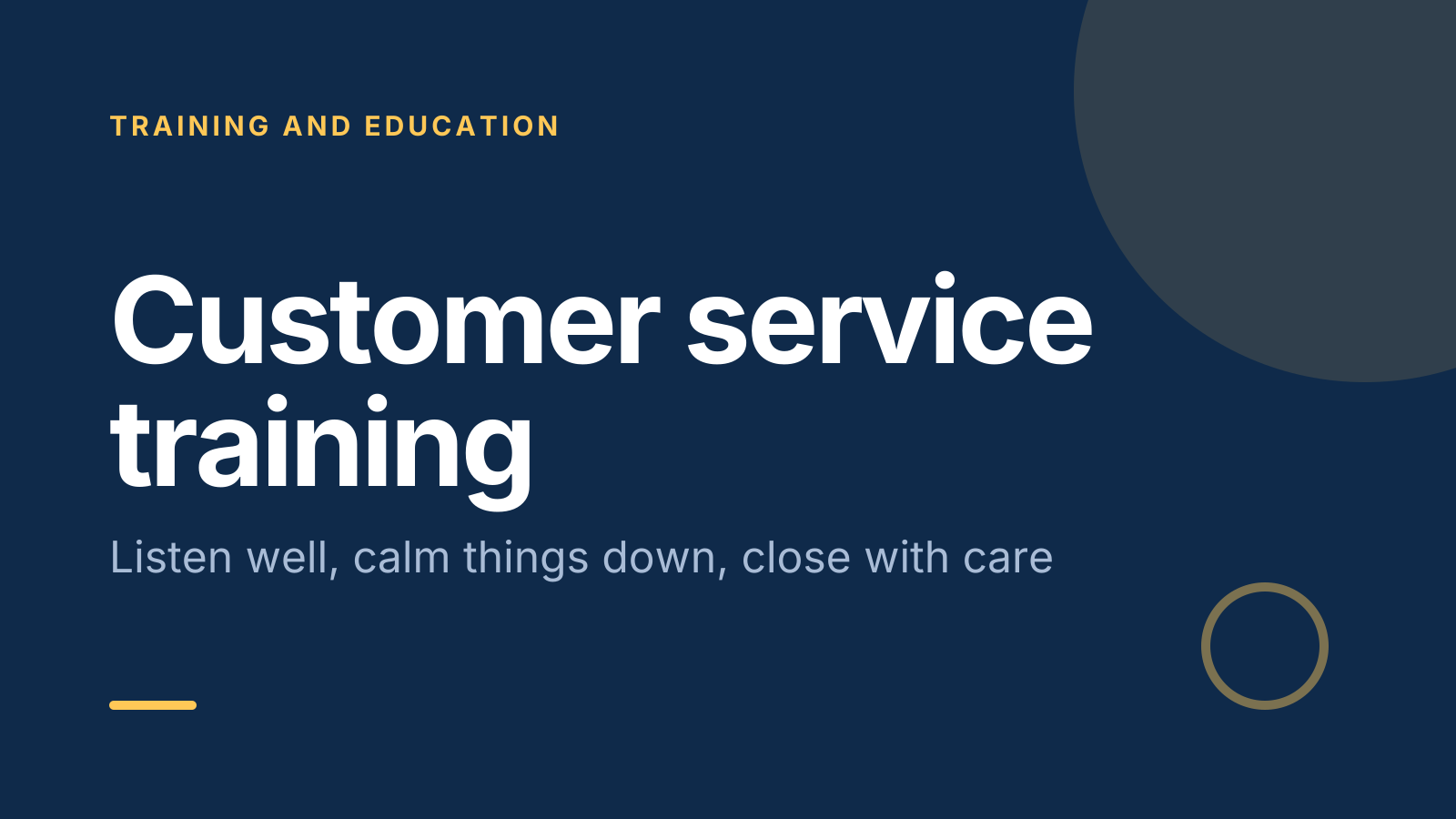
What’s inside
- 1 · Welcome
 2 · Today
- 3 · PollPollAnonymous
What’s the hardest part of customer conversations for you?
- ACalming upset customers
- BSaying no without losing them
- CExplaining complicated things
- DStaying patient on busy days
 4 · Section
- 5 · Listen first, then solve
Listen first, then solve
- 1Let them finishDon’t interrupt the first explanation, even if you already know the answer. People calm down once they feel fully heard.
- 2Reflect it backSum it up in one line: “So the order came late and the wrong size. Is that right?” It shows you listened and checks the facts.
- 3Ask what good looks like“What would a good outcome be for you?” tells you what they need before you offer a fix that misses the point.
- 6 · Calming an upset customer
Calming an upset customer
- 1Acknowledge the feeling“I can see why that’s frustrating” recognises how they feel without arguing the facts or admitting fault.
- 2Slow your pace and volumeSpeak a little slower and quieter than the customer. People tend to match the tone they hear back.
- 3Name the next step and time“I’ll check with the warehouse and call you back by 3 pm.” A specific promise calms people, so keep it.
- 7 · Saying no and closing well
Saying no and closing well
- 1Lead with what you can doSwap “We can’t refund that” for “What I can do is replace it today.” Same policy, a very different feeling.
- 2Give the reason brieflyOne honest sentence on why helps people accept a no. Skip policy jargon and long justifications.
- 3Confirm before you closeRecap what happens next and ask “Is there anything else I can help with today?” so nothing is left hanging.
 8 · Discussion
- 9 · QuizQuiz
A customer is angry about a late order. What should you do first?
- AExplain the delivery policy
- BLet them finish and acknowledge itCorrect
- COffer a discount straight away
- DPass them to a manager
 10 · Key takeaways
- 11 · Pick a volunteerPick a volunteer
Who role-plays the next call?
Type CALL in the chat to be in the draw.
 12 · Next steps
 13 · Close
Show of hands, or everyone’s answer
The first poll works with hands up. Here’s the same question in a sample room of 20, answered live. Tap an answer to join in.
Show of hands
What’s the hardest part of customer conversations for you?
About 5 hands go up, the same ones as always. You hear the loudest people, not the room.
Live in Claryoo · 0 of 20 answered · anonymous
LiveWhat’s the hardest part of customer conversations for you?
Eight people find saying no the hardest part. Nobody would admit that out loud in front of the team. Run it live, free
What the session covers
1.Listen first, then solve
Let them finish
Don’t interrupt the first explanation, even if you already know the answer. People calm down once they feel fully heard.
Reflect it back
Sum it up in one line: “So the order came late and the wrong size. Is that right?” It shows you listened and checks the facts.
Ask what good looks like
“What would a good outcome be for you?” tells you what they need before you offer a fix that misses the point.
2.Calming an upset customer
Acknowledge the feeling
“I can see why that’s frustrating” recognises how they feel without arguing the facts or admitting fault.
Slow your pace and volume
Speak a little slower and quieter than the customer. People tend to match the tone they hear back.
Name the next step and time
“I’ll check with the warehouse and call you back by 3 pm.” A specific promise calms people, so keep it.
3.Saying no and closing well
Lead with what you can do
Swap “We can’t refund that” for “What I can do is replace it today.” Same policy, a very different feeling.
Give the reason briefly
One honest sentence on why helps people accept a no. Skip policy jargon and long justifications.
Confirm before you close
Recap what happens next and ask “Is there anything else I can help with today?” so nothing is left hanging.
How to run it, slide by slide
About 73 minutes in all. These notes come with the PowerPoint as speaker notes, so you see them while you present.
- 1Welcome2 min
“Welcome. Today is about the conversations that make or break a customer’s day, and the words that help.”
Keep it short and warm. Mention it is practical and everyone will practise.
- 2Today2 min
“We’ll look at where conversations get hard, learn three skills with real phrases, then practise and commit to one change.”
Point out that the role-play is in pairs, so nobody performs in front of the whole room.
- 3Poll4 min
“Answer honestly, this is anonymous. Which part of customer conversations is hardest for you?”
Read the top answer aloud and say you’ll spend extra time on it. If one option is tiny, say it’s good to see that one feels easier.
- 4Section1 min
“Three skills: listen first, calm things down, and say no while keeping the customer.”
Move straight into the first lesson.
- 5Listen first, then solve10 min
“Most complaints get worse because the customer doesn’t feel heard, not because the fix is wrong.”
Model a bad and a good version of reflecting back. Ask the room which felt better to hear and why.
- 6Calming an upset customer10 min
“You can’t solve a problem while someone is still upset. Calm comes first, then the fix.”
Ask for phrases people already use that work. Write the best two up next to the slide.
- 7Saying no and closing well10 min
“A no handled well can keep a customer longer than a yes handled badly.”
Ask each table to turn one common no from your own work into a “what I can do” line.
- 8Discussion12 min
“Think of a real moment that went badly. In pairs, one plays the customer, one the agent, then swap and try the new phrases.”
Give 5 minutes per round. Walk around and listen for acknowledgement and a clear next step. Ask two pairs to share one line that worked.
- 9Quiz4 min
“Quick check. A customer is angry about a late order. What should you do first?”
- 10Key takeaways3 min
“If you remember three things: let them finish and reflect back, acknowledge the feeling, and lead with what you can do.”
Ask each person to underline the one they most need to work on.
- 11Pick a volunteer8 min
“Let’s see one call in front of everyone. I’ll play the customer.”
Run a 3 minute role-play with the person picked. Ask the room what worked and one thing to try next time. Thank them warmly.
- 12Next steps4 min
“Before you go, pick the phrase you’ll use first and write it where you’ll see it during calls.”
Ask two or three people to read their phrase aloud. Agree when you’ll swap tricky cases as a team.
- 13Close3 min
“Thank you. Every customer deserves to feel heard, and you now have the words to do it.”
Take questions. Share the phrases from today with the team afterwards.
About this customer service training template
Most customer service training slides list values like empathy and patience, then stop. This free customer service training PPT teaches the skills behind them. Three lessons cover listening before you solve, calming an upset customer, and saying no while keeping the relationship. Every point comes with a phrase your team can use on their next call or chat.
It is built for team leads, trainers and support managers running a 60 to 90 minute session. An anonymous opening poll shows which conversations your team finds hardest, a quiz checks the key idea, and a paired role-play gives everyone practice. The speaker notes tell you what to say, how long each part takes and what to do if the room goes quiet.
When to use it
- Onboarding new support, retail or front desk staff
- Refreshing skills after a run of complaints or low satisfaction scores
- Preparing a team for a busy season, a price change or a product launch
How to use it
- Download the PowerPoint. Every word is editable text, so add your name, your examples and your logo. For Google Slides, upload the file to Google Drive and open it with Google Slides. It also opens in Keynote.
- Read the first slide. It’s hidden when you present and lays out the session minute by minute. Each slide’s speaker notes say what to say, what to do and how long it takes.
- Run the polls your way. Hands up works in any room. To get everyone’s answer, anonymous when it matters, run the same deck live with Claryoo on a Zoom, Google Meet or Teams call, or in the room by QR code. Already edited your PowerPoint? Save it as a PDF and add it to your Claryoo deck.
More on live polls, quizzes and pick a volunteer, or spin the free wheel of names.