Claryoo
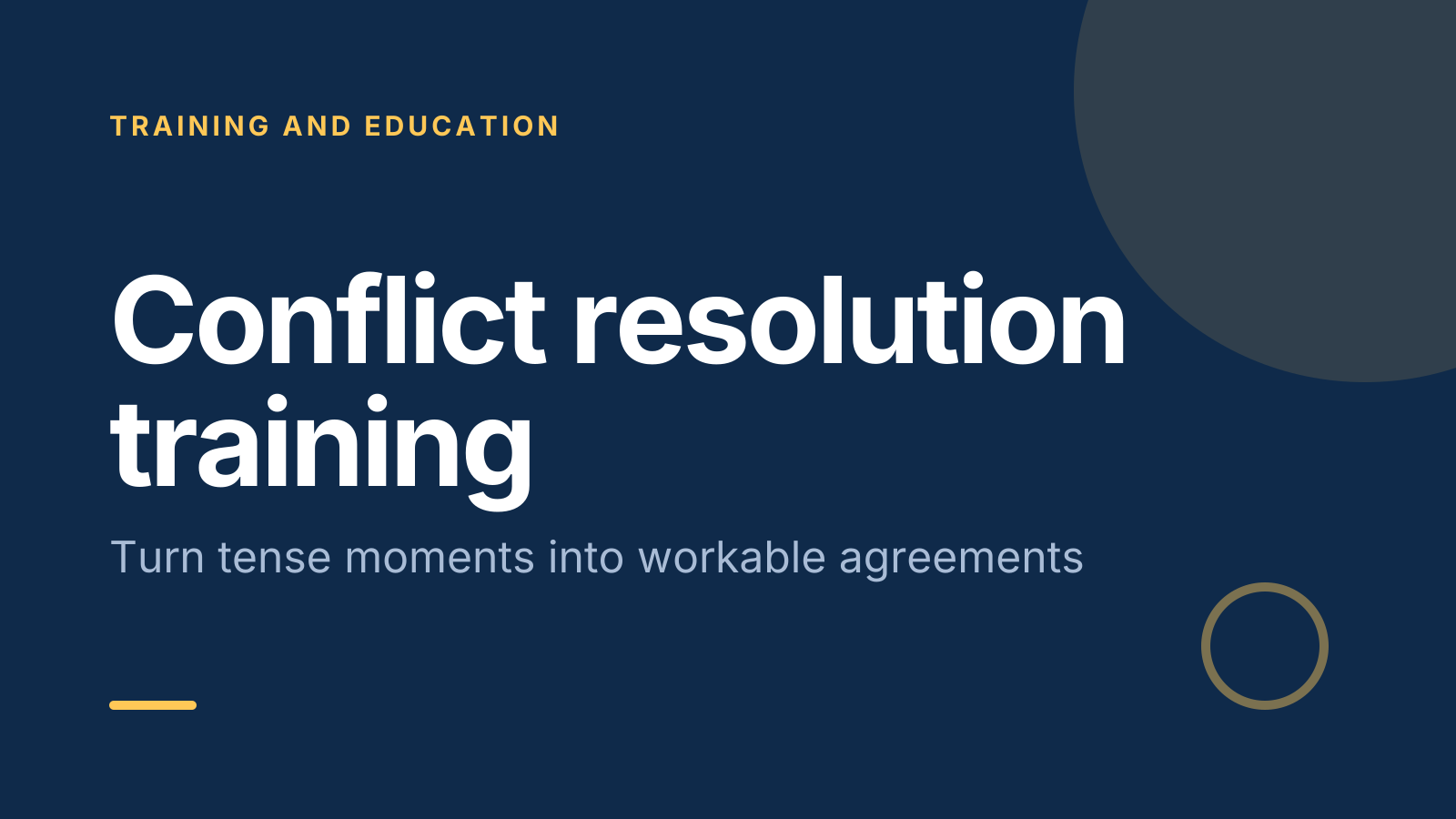
Conflict resolution training PPT with phrases and role-play
A free conflict resolution training PowerPoint template: 14 slides with speaker notes, a poll, a quiz and a volunteer pick. Edit it in PowerPoint or Google Slides, or run it live on Zoom, Meet, Teams or in the room.
Free, no sign-up. 14 slides, about 71 minutes, speaker notes on every slide. Opens in PowerPoint, Google Slides and Keynote.
What’s inside
- 1 · Welcome
 2 · Today
- 3 · PollPollAnonymous
When conflict comes up at work, what do you usually do?
- AAvoid it and hope it passes
- BGive in to keep the peace
- CPush for my view
- DLook for a middle ground
 4 · Section
- 5 · Understand what’s really going on
Understand what’s really going on
- 1Separate person and problemTalk about the issue, not someone’s character. “The handover was late” lands better than “You’re careless”.
- 2Find interests behind positionsA position is what someone asks for, the interest is why. Ask “What matters most to you here?” to find it.
- 3Know your default styleMost of us lean to avoiding, giving in, competing, compromising or collaborating. Notice yours and when it doesn’t fit.
- 6 · Talk it through calmly
Talk it through calmly
- 1Choose the momentTalk privately and soon, once emotions have cooled: “Have you got 15 minutes today to talk about the handover?”
- 2Use “I” statementsSay what happened, its effect and what you need: “When the report came late, I missed my deadline. Can we agree a time?”
- 3Listen to understandLet them finish, then summarise their view before giving yours. People listen better once they feel understood.
- 7 · Agree a way forward
Agree a way forward
- 1Generate options togetherList several options before judging any. Ask “What could we try?” so both people own the solution.
- 2Agree specific actionsSettle who does what by when. “Status update by Tuesday noon” works better than “communicate better”.
- 3Follow upBook a short check in a week or two later to see if the agreement holds, and adjust it together if it doesn’t.
 8 · Discussion
- 9 · QuizQuiz
Which of these is an “I” statement?
- AYou never listen to me
- BI felt left out when plans changedCorrect
- CEveryone thinks you’re wrong
- DWhy do you always do this?
 10 · Key takeaways
- 11 · Pick a volunteerPick a volunteer
Who tries the next role-play?
Type PRACTICE in the chat to be in the draw.
 12 · Next steps
 13 · Close
Show of hands, or everyone’s answer
The first poll works with hands up. Here’s the same question in a sample room of 20, answered live. Tap an answer to join in.
Show of hands
When conflict comes up at work, what do you usually do?
About 5 hands go up, the same ones as always. You hear the loudest people, not the room.
Live in Claryoo · 0 of 20 answered · anonymous
LiveWhen conflict comes up at work, what do you usually do?
Twelve people avoid conflict or give in. That is where the practice needs to go, and nobody had to say it out loud. Run it live, free
What the session covers
1.Understand what’s really going on
Separate person and problem
Talk about the issue, not someone’s character. “The handover was late” lands better than “You’re careless”.
Find interests behind positions
A position is what someone asks for, the interest is why. Ask “What matters most to you here?” to find it.
Know your default style
Most of us lean to avoiding, giving in, competing, compromising or collaborating. Notice yours and when it doesn’t fit.
2.Talk it through calmly
Choose the moment
Talk privately and soon, once emotions have cooled: “Have you got 15 minutes today to talk about the handover?”
Use “I” statements
Say what happened, its effect and what you need: “When the report came late, I missed my deadline. Can we agree a time?”
Listen to understand
Let them finish, then summarise their view before giving yours. People listen better once they feel understood.
3.Agree a way forward
Generate options together
List several options before judging any. Ask “What could we try?” so both people own the solution.
Agree specific actions
Settle who does what by when. “Status update by Tuesday noon” works better than “communicate better”.
Follow up
Book a short check in a week or two later to see if the agreement holds, and adjust it together if it doesn’t.
How to run it, slide by slide
About 71 minutes in all. These notes come with the PowerPoint as speaker notes, so you see them while you present.
- 1Welcome2 min
“Welcome. Conflict is normal wherever people care about their work. Today is about handling it well.”
Set ground rules: examples stay in the room, and no real disputes between people here.
- 2Today2 min
“We’ll see how we handle conflict now, learn three steps to understand, talk and agree, then practise.”
Reassure people that role-plays use made-up or low-stakes situations.
- 3Poll4 min
“This is anonymous. When conflict comes up at work, what do you usually do?”
Read the spread without judging any style. If avoiding is high, say it is the most common response and today gives an easier way in.
- 4Section1 min
“Three steps: understand what is going on, talk it through, agree a way forward.”
Move straight into the first lesson.
- 5Understand what’s really going on10 min
“Most conflicts are about something underneath the thing people are arguing over.”
Give a simple example, like two people wanting the same meeting room, and ask the room for the interests behind each position.
- 6Talk it through calmly10 min
“How a conversation starts usually decides how it ends.”
Read a blaming sentence aloud and have pairs rewrite it as an “I” statement. Share two.
- 7Agree a way forward8 min
“An agreement only counts if both people know exactly what happens next.”
Ask the room for vague agreements they’ve heard, then turn one into a specific action together.
- 8Discussion14 min
“In trios, one person opens a conversation they’ve been putting off, one listens and summarises, one observes. Then swap.”
Run three 4 minute rounds. Observers note one thing that helped. Ask for two or three useful opening lines.
- 9Quiz4 min
“Quick check. Which of these is an “I” statement?”
- 10Key takeaways3 min
“Keep three things: focus on the issue not the person, use “I” statements and listen, and agree who does what by when.”
Ask which one people find hardest. It is usually listening without jumping in.
- 11Pick a volunteer6 min
“Let’s try one together in front of the group. I’ll play the other person.”
Keep it short and kind. Ask the room what worked, then thank the volunteer warmly.
- 12Next steps4 min
“Before you go, pick one conversation you’ve been avoiding and write your opening “I” statement.”
Give two minutes to write it. Nobody has to share. Remind people to involve HR or a manager for serious issues.
- 13Close3 min
“Thank you. The first sentence is the hardest part, and you now have one ready.”
Take questions. Offer one-to-one support for anyone with a difficult situation.
Techniques that work in this session
From the facilitator playbook: step-by-step, with a short video. Swap one into the discussion slide.

ORID: the focused conversation method
Four levels of questions, from facts to feelings to meaning to action. Ends arguments about interpretations.
15 to 45 min3 to 25

Quiet participants, dominant talkers and tangents
Why quiet people stay quiet, how to rein in the loud ones without drama, and a parking lot that works.
Any timeAny size
About this conflict resolution training template
Conflict at work rarely goes away on its own, but most people were never shown how to handle it. This free conflict resolution training PPT walks through three steps: understanding what is really going on, talking it through calmly, and agreeing a way forward. Each point gives a phrase or technique to use in a real conversation.
It is for HR, trainers and team leads running a 60 to 90 minute session. An anonymous opening poll shows how your group tends to handle conflict, a quiz checks the “I” statement idea, and role-plays in trios give everyone safe practice. The speaker notes tell you what to say, how long each part takes and how to keep the room safe.
When to use it
- Training new managers to handle disagreements in their team
- Helping a team after a period of tension or a difficult change
- Building communication skills in customer-facing or cross-team roles
How to use it
- Download the PowerPoint. Every word is editable text, so add your name, your examples and your logo. For Google Slides, upload the file to Google Drive and open it with Google Slides. It also opens in Keynote.
- Read the first slide. It’s hidden when you present and lays out the session minute by minute. Each slide’s speaker notes say what to say, what to do and how long it takes.
- Run the polls your way. Hands up works in any room. To get everyone’s answer, anonymous when it matters, run the same deck live with Claryoo on a Zoom, Google Meet or Teams call, or in the room by QR code. Already edited your PowerPoint? Save it as a PDF and add it to your Claryoo deck.
More on live polls, quizzes and pick a volunteer, or spin the free wheel of names.