Claryoo
A board meeting presentation template for clear decisions
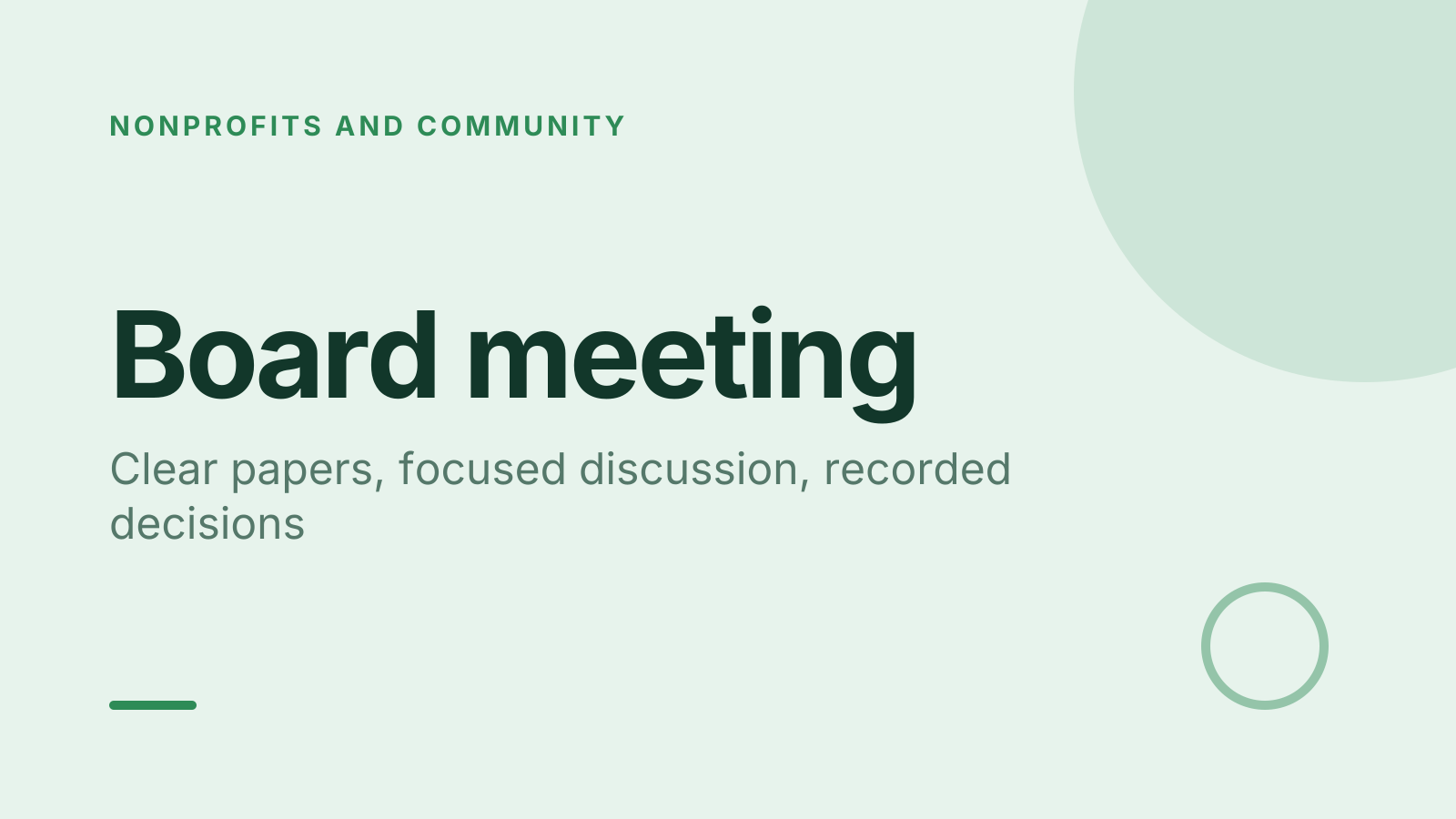
A free board meeting PowerPoint template: 12 slides with speaker notes, 3 polls. Edit it in PowerPoint or Google Slides, or run it live on Zoom, Meet, Teams or in the room.
Free, no sign-up. 12 slides, about 60 minutes, speaker notes on every slide. Opens in PowerPoint, Google Slides and Keynote.
What’s inside
- 1 · Welcome
 2 · Today
- 3 · PollPollAnonymous
How well do you understand this quarter’s finance report?
- AFully
- BMostly
- CPartly
- DNot really
 4 · Section
- 5 · How we run this meeting
How we run this meeting
- 1Quorum and conflicts firstCheck enough members are present to make decisions. Anyone with a conflict on an item declares it and steps out of that vote.
- 2Consent agendaRoutine items like minutes and standard reports are approved together without discussion. Any member can ask to pull one out.
- 3Decide, then recordEach decision is read back in one sentence with an owner and a date, so the minutes match what the board actually agreed.
- 6 · Reading the finances in five minutes
Reading the finances in five minutes
- 1Budget against actualLook at the gap between what we planned and what happened. Ask about any line that is far off, not every small difference.
- 2Cash and reservesCheck how many months of running costs our unrestricted reserves would cover, and compare that with our reserves policy.
- 3Restricted vs unrestrictedRestricted money can only be spent on what the donor gave it for. It can’t cover a gap in general running costs.
 7 · Discussion
- 8 · PollPoll
Which item needs the most time today?
- AFinances
- BStrategy
- CRisks
- DFundraising
 9 · Key takeaways
- 10 · PollPollAnonymous
How well did this meeting use our time?
- AVery well
- BFairly well
- CNot well
 11 · Next steps
 12 · Close
Show of hands, or everyone’s answer
The first poll works with hands up. Here’s the same question in a sample room of 9, answered live. Tap an answer to join in.
Show of hands
How well do you understand this quarter’s finance report?
About 3 hands go up, the same ones as always. You hear the loudest people, not the room.
Live in Claryoo · 0 of 9 answered · anonymous
LiveHow well do you understand this quarter’s finance report?
Three board members are unsure about the numbers they’re about to approve. None would say so out loud. Run it live, free
What the session covers
1.How we run this meeting
Quorum and conflicts first
Check enough members are present to make decisions. Anyone with a conflict on an item declares it and steps out of that vote.
Consent agenda
Routine items like minutes and standard reports are approved together without discussion. Any member can ask to pull one out.
Decide, then record
Each decision is read back in one sentence with an owner and a date, so the minutes match what the board actually agreed.
2.Reading the finances in five minutes
Budget against actual
Look at the gap between what we planned and what happened. Ask about any line that is far off, not every small difference.
Cash and reserves
Check how many months of running costs our unrestricted reserves would cover, and compare that with our reserves policy.
Restricted vs unrestricted
Restricted money can only be spent on what the donor gave it for. It can’t cover a gap in general running costs.
How to run it, slide by slide
About 60 minutes in all. These notes come with the PowerPoint as speaker notes, so you see them while you present.
- 1Welcome2 min
“Welcome, everyone. We have a quorum, so let’s begin. Does anyone have an interest to declare on today’s items?”
Note apologies, confirm quorum and record any declared conflicts in the minutes.
- 2Today3 min
“Here’s today’s agenda. Can we approve the minutes of the last meeting and the consent items together?”
Ask if anyone wants an item moved off the consent agenda. If not, take approval in one go and note it.
- 3Poll4 min
“Before we look at the numbers, I want an honest sense of how clear the finance report was.”
If two or more say partly or not really, ask the treasurer to slow down and explain the key lines. Don’t name anyone.
- 4Section1 min
“Let’s look at where we stand, starting with how we run this meeting.”
Move into the first teaching slide.
- 5How we run this meeting8 min
“A few simple rules keep this meeting short and our decisions sound.”
Point to the conflicts register. Remind members that papers are read before the meeting, not during it.
- 6Reading the finances in five minutes12 min
“Every one of us shares responsibility for the finances, so let’s make sure they’re clear to everyone.”
Ask the treasurer to walk through the three points using this quarter’s figures. Invite questions on each before moving on.
- 7Discussion15 min
“Here’s the decision in front of us. I’ll go round the table for one point each before we decide.”
Hear every member once before open debate. State the proposal, take the vote and read back the decision for the minutes.
- 8Poll5 min
“We have limited time left, so let’s choose where to spend it.”
Give the top item most of the remaining time. Park the rest for the next meeting or a subgroup.
- 9Key takeaways3 min
“Let me sum up what we decided today.”
Read each decision with its owner and date. Ask the secretary to confirm they have it right.
- 10Poll2 min
“Finally, a quick and anonymous rating of how well this meeting used our time.”
If not well comes up, ask for one change by email before the next meeting.
- 11Next steps4 min
“Here are the actions for everyone before we meet again.”
Confirm the date of the next meeting and when papers will go out.
- 12Close1 min
“Thank you, everyone. The meeting is closed.”
Note the closing time for the minutes.
Techniques that work in this session
From the facilitator playbook: step-by-step, with a short video. Swap one into the discussion slide.

Fist to five: check agreement in one minute
Everyone shows 0 to 5 fingers on a proposal. Anyone under 3 gets heard before you move on.
1 to 10 min3 to 50
Consensus decision making, step by step
Six steps to a decision everyone can live with, and four clear ways to say yes, no or not quite.
20 to 60 min3 to 30
About this board meeting template
This board meeting presentation template is for chairs, executive directors and secretaries of nonprofits, charities and associations. It follows a 60 minute agenda: opening business and minutes, the finances and key reports, then the decisions the board needs to make, with every action recorded and given an owner before people leave.
Two teaching slides set the ground rules and walk the board through reading the finances. Speaker notes tell the chair what to say and how long to spend. An anonymous poll checks whether everyone really understands the finance report, another lets the board choose where to spend its time, and a closing poll rates the meeting itself.
When to use it
- Running a regular quarterly board or trustee meeting
- Presenting the finances to a board with mixed financial confidence
- Bringing structure to a board whose meetings tend to overrun
How to use it
- Download the PowerPoint. Every word is editable text, so add your name, your examples and your logo. For Google Slides, upload the file to Google Drive and open it with Google Slides. It also opens in Keynote.
- Read the first slide. It’s hidden when you present and lays out the session minute by minute. Each slide’s speaker notes say what to say, what to do and how long it takes.
- Run the polls your way. Hands up works in any room. To get everyone’s answer, anonymous when it matters, run the same deck live with Claryoo on a Zoom, Google Meet or Teams call, or in the room by QR code. Already edited your PowerPoint? Save it as a PDF and add it to your Claryoo deck.
More on live polls, quizzes and pick a volunteer, or spin the free wheel of names.